Places to Shoot in London #1: Las Vegas Arcade (Soho) by Leung-Kit To

Ruby-8.jpg

Places to Shoot in London #1: Las Vegas Arcade (Soho)


I often get comments on my Instagram asking where a photo was taken. I'm starting this series is in response to those comments.

When it comes to photographs, everyone has a preference - a certain style or vibe that makes you fall in love with it. The vibe that I'm obsessed with is an American - summer - teen - IDGAF vibe. A lot of these photos I love are taken in diners or arcades, which is a classic setting for a teen flick. These locations also have really great neon lights, so if you were looking to shoot with a neon background - diners and arcades are where to go.

There's a couple arcades in London that I shoot at, but one that I had the most success with was Las Vegas Arcade in Soho. I started shooting there in 2016, but it's gradually gotten busier and busier each time I visit (maybe due to the Supreme store around the corner). This arcade has beautiful cool neon lights. Here's a quick brief rundown of the machines they have for photography purposes; a claw machine, two dance machines, lots of driving machine, pool tables, air hockey, etc. For fun purposes; they have an awesome Japanese button mashing game, Street Fighter, Tekken, Guitar Hero, Time Crisis, etc.

Ruby

Ruby

Jodie

Jodie

Summer

Summer

Shooting Tips

When shooting with neon lights, be cautious to take several shots at a time due to the lights flickering. One photo might be really blue, and another dull without the neon light. In here I usually shoot at my widest aperture or if I'm near a machine stop down to f/2.8. Shoot at over 1/100 due to the lights, and adjust your ISO accordingly. You want to blur the background and get really nice bokeh, and to allow as much light as possible because it's quite dark in there.

Key places I shoot are the claw machine, the driving games, and the air hockey table. These place are usually the most lit areas (pun intended). I have found shooting through the glass of the Claw Machine creates really soft reflections that's quite flattering. It's especially handy if it's busy in there, by blurring the background into a beautiful mash of colours. 


If you have any questions, feel free to leave them in the comments below and I'll get back to you as soon as possible.

Composition Techniques: Symmetry & Centred Subject by Leung-Kit To

Huntar, an example of Symmetrical Composition

Huntar, an example of Symmetrical Composition

Symmetry & Centred Subjects


These two composition technique are fairly straight forward, but incredible effective. Like with the Rule of Thirds, there are key areas where peoples' eyes are particularly drawn to - the centre of the frame being the most popular. This is one of the most common framing techniques, dating back to the beginning of photography.

Sophie, an example of a Centred Subject

Sophie, an example of a Centred Subject

By placing the subject in the centre of the frame, it helps the viewers to easily identify the main subject of the frame. When shot at a wide aperture, it allows for an evenly spaced background blur which adds depth to the photo and brings the focus (no pun intended) to the foreground subject.

Minna, an example of a Centred Subject

Minna, an example of a Centred Subject

A symmetrical shot is incredible pleasant to view. It creates a balance in the photo. You can find lots of examples of this in urban architecture photographs or cityscape shots. In the case of the photos with Huntar, and Lotta, the symmetrical background helps to balance out the background and to bring interest to the subject.

Lotta, an example of Symmetrical Composition

Lotta, an example of Symmetrical Composition

Let me know in the comments below what techniques you would like me to explore next.

Composition Techniques: What is the Rule of Thirds? by Kip Photography

Gudlaug, an example of Rule of Thirds

Gudlaug, an example of Rule of Thirds

What is the Rule of Thirds?

This post is the first in a series on Composition Techniques. The aim of this series is to explore composition techniques that budding photographers should be experimenting with.


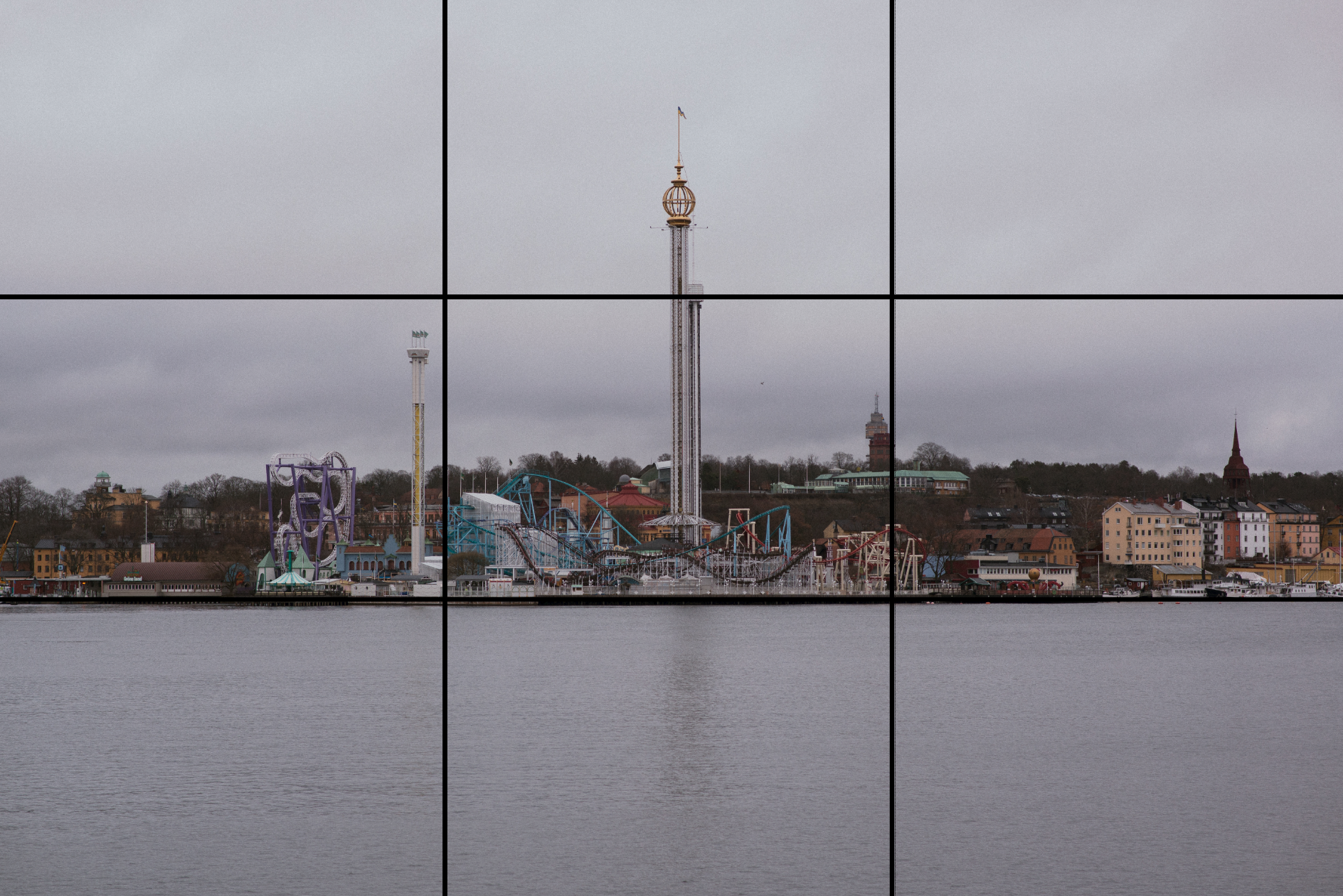
The rule of thirds is a framing technique that is used in paintings, film, and photographs. This technique should be one of the first compositional technique any photographer learns, because it's so versatile. It applies to photos no matter the aspect ratio or orientation. 

The composition is divided evenly into 9 parts by two evenly spaces horizontal and two evenly spaced vertical lines. If you're shooting video or stills, the LiveView mode on your camera can enable the rule of thirds grid. This technique is really handy in helping you frame a photo for several reasons. 

Jodie, an example of Rule of Thirds

Jodie, an example of Rule of Thirds

One, people are particularly drawn to the area where the lines intersect. It's ideal to frame the main subject of the photo accordingly, such as framing the eyes of the subject where the lines are - making them more of the focus. This is particular important when taking traditional portraits.

Oslo, an example of Rule of Thirds

Oslo, an example of Rule of Thirds

The rule of thirds can help you straighten the horizon, and to leave empty space in the composition appropriately (as seen in the picture above, and the picture of Gudlaug on the ship). It's important to sometimes have an space around the subject to help balance out the photo, and to set a scene.


Let me know in the comments below what techniques you would like me to explore next.

Getting Started: Choosing Your First Camera by Kip Photography

IMG_9450.jpg

Your First Camera


Buying a camera is a luxury. You should do as much research as you can before your purchase. That said, you should not be worrying yourself if your camera can not shoot 4K or 12 fps burst. Your first camera should be something that feels comfortable in the hands, and reliable. Remember, this camera is for helping your learn and discover how you shoot.

I got into Photography through a high school project, and I started taking pictures of everything with my phone. It didn't have the best camera, but it helped me discover what I was passionate shooting, and develop basic framing techniques. My first camera was the Nikon D3100 - an entry level DSLR from Nikon. I shot a lot with that little guy and its kit lens. It had good 1080p video quality for its time, and the 18-55mm had good range for the things I was shooting. Looking back, the only downside was the aperture, but it didn't affect me then.

Recommendations


Nikon D3400 + 18-55mm VR f/3.5-5.6


The D3400 is an updated version of the entry level I previously used. It's available with two lens options; 18-55mm f/3.5-5.6 and 18-105mm f/3.5-5.6. Both lenses have vibration reduction (VR) modes which is handy for shooting video handheld, but should be disabled when shooting photos on a tripod. The D3400 is also equipped with the ability to transfer photos to phone via Bluetooth.

  • Megapixel: 24.72 megapixels
  • Screen Size: 3 inches
  • Sensor Size: 23.5 x 15.6 mm
  • ISO Range: 100- 25600
  • Continuous Shooting Speed: 5fps
  • Connectivity Technology: Bluetooth
  • Weight: 445g


Canon 2000D + 18-55mm f/4-5.6


The 2000D is Canon's equivalent to the Nikon D3400. The lens is similar in image quality to Nikon's equivalent, and also includes an image stabiliser - which reduces vibrations in video. The 2000D comes with a wireless feature that allows you to transfer photos from camera to phone through Canon's App.

Both cameras are more than suitable for someone starting to learn photography. They're both equipped with 24 megapixels and full 1080p video.

  • Megapixel: 24.1 megapixels
  • Screen Size: 3 inches
  • Sensor Size: 22.3 mm x 14.9 mm
  • ISO Range: 100-6400
  • Continuous Shooting Speed: 3fps
  • Connectivity Technology: WiFi, Bluetooth
  • Weight: 445g

Buying Used


Buying used cameras is also another great alternative. You can usually find used entry level cameras for a fraction of the original price. It might even be worth getting an older model, e.g. D3300 instead of D3400 just to save money - which could be used to purchase a much needed lens later on.


A Basic Setup


Below is a list I've compiled for a basic camera setup focussing on primes. This list is not intended to be a shopping list for someone to get all at once. I believe most photographers will end up with most of these lenses by a year or two into shooting. The list is a guideline on what lenses will cover your needs - you can still create art with a beaten up, weathered 18-55 Kit Lens.  

Canon has better price to quality ratio for EF-S prime lenses (for cropped sensors). The Canon 50mm f/1.8 is an incredible lens for sharp portraits. At a wide aperture of f/1.8, it performs well in low light. The Yongnuo is a third party version of Canon's, it has been seen to perform just as well at half the price. 

Nikon's lenses are far pricier in comparison to Canon's equivalent. The 50mm and 85mm f/1.8 I've recommended are for FX bodies (full frame sensor), which means they'll be around 75mm and 125mm on a Nikon DX body (crop sensor). Bear this in mind, when you upgrade your camera body down the line these lenses will still be usable. The 35mm f/1.8G is a DX lens, it will perform great as a street photography lens - or just an every day lens.

Nikon

Nikon D3400 Body Only or Nikon D3400 with Kit Lens

Nikon 35mm f/1.8G

Nikon 50mm f/1.8G

Nikon 85mm f/1.8G 


If you have any questions, feel free to leave them in the comments below and I'll get back to you as soon as possible.